





















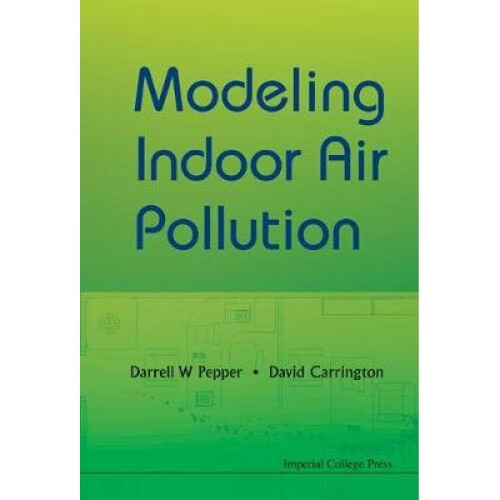
Modeling Indoor Air Pollution
In stock
Smart shoppers OnBuy it!
- Earn Cashback on every purchase – spend it instantly on your next order
- Free delivery – on millions of items across the site
- Customers love us – 129,000 Trustpilot reviews and an 'Excellent' rating
Interest-free payment options available


See full product description & details
Delivery: Standard (Free) | Fri 31st Jul - Mon 3rd Aug
Sold by: PBShop
Returns: 30 days
180-day payment protection
Modeling Indoor Air Pollution Description
Emission of pollutants and their accumulation due to poor ventilation and air exchange are serious problems currently under investigation by many researchers. Of particular concern are issues involving air quality within buildings. Toxic fumes and airborne diseases are known to produce undesirable odors, eye and nose irritations, sickness, and occasionally death. Other products such as tobacco smoke and carbon monoxide can also have serious health effects on people exposed to a poorly ventilated environment; studies indicate that indirect or passive smoking can also lead to lung cancer.Design for prevention or remediation of indoor air pollution requires expertise in optimizing geometrical configurations; knowledge of HVAC systems, perceived or expected contaminants and source locations; and economics. Much of the design concept involves ways in which to optimize the benefits or balance the advantages and disadvantages of various configurations and equipment. The fact that a room or building will conceivably become contaminated is generally an accepted fact to what extent indoor air pollution will become critical is not really known until it happens.A series of numerical models that run in MATLAB are described in the text and placed on the Web. These models include the finite difference method, finite volume method, finite element method, the boundary element method, particle-in-cell, meshless methods, and lagrangian particle transport. In addition, all example problems can be run using COMSOL, a commercial finite-element-based computer code with a great deal of flexibility and application. By accessing AutoCad ICES or DWG file structures, COMSOL permits a building floor plan to be captured and the interior walls discretized into elements.
Details
| OPC | P6MRQ5S |
|---|---|
| Codes | 184816324X (ISBN-10) |
| 9781848163249 (ISBN) |
Compare Sellers for Modeling Indoor Air Pollution
- New from £111.19
| Seller | Ratings | Warranty | Returns | Price | Delivery | Total | Quantity |
|---|---|---|---|---|---|---|---|
| (2.7k reviews) | - |
30 Days
Free Returns No
|
£111.19
|
+Free Delivery
Est. Delivery:
31st Jul - 3rd Aug
|
£111.19
|
Earn as you shop with instant Cashback on everything.
No catch, no cost
- Paid into your OnBuy account
- Spend it on your next purchase
- Save it or withdraw it
Become a Cashback VIP
Just 1 purchase unlocks bigger deals & rates