






















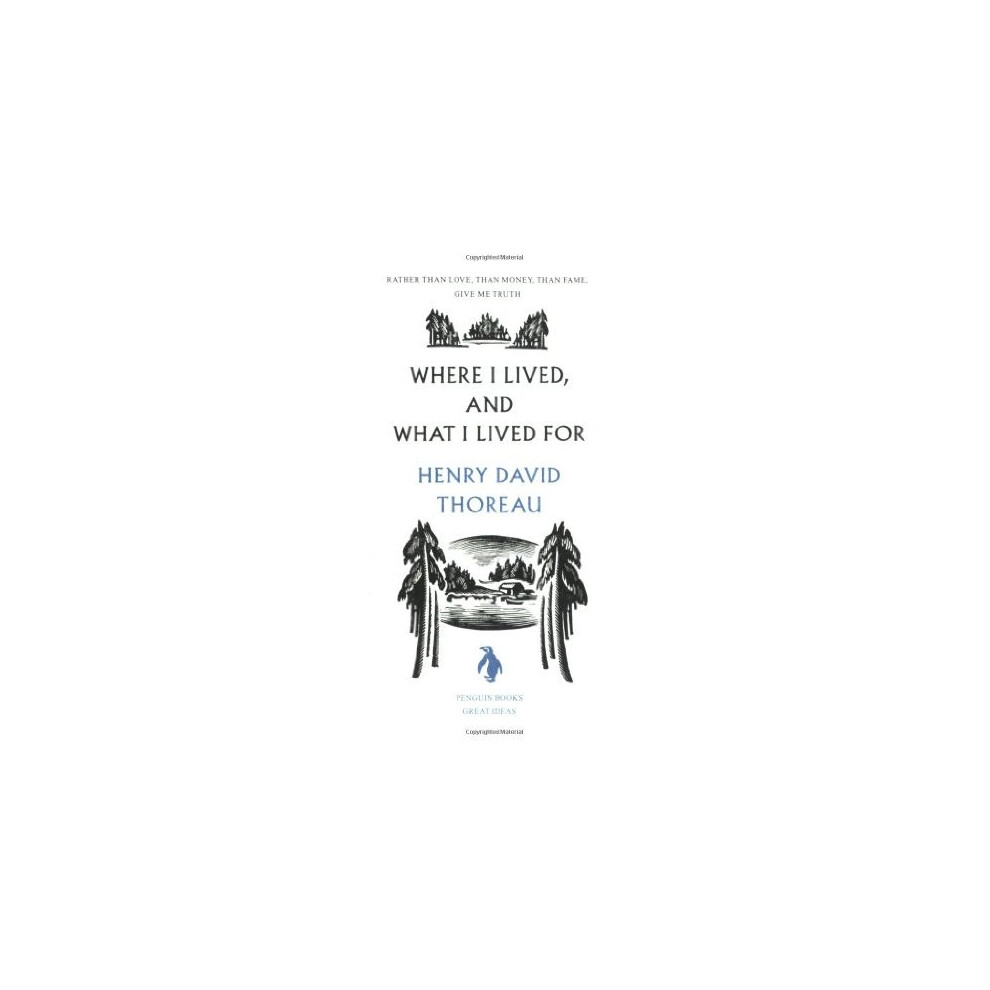
Where I Lived, and What I Lived for
In stock
Smart shoppers OnBuy it!
- Earn Cashback on every purchase – spend it instantly on your next order
- Free delivery – on millions of items across the site
- Customers love us – 136,000 Trustpilot reviews and an 'Excellent' rating
Interest-free payment options available


See full product description & details
Delivery: Standard (£3.00) | Wed 28th Oct - Mon 16th Nov
Returns: 30 days
180-day payment protection
You might also like









Where I Lived, and What I Lived for Description
Where I Lived, and What I Lived for by Thoreau, Henry David
Details
| OPC | PD7ZMY |
|---|---|
| Codes | 0143037587 (ISBN-10) |
| 9780143037583 (ISBN) |
Disclaimer: The information below is provided by various external sources and should be used as a guide only.
Where I Lived, and What I Lived For
The perfect books for the true book lover, Penguin’s Great Ideas series features twelve more groundbreaking works by some of history’s most prodigious thinkers. Each volume is beautifully packaged with a unique type-driven design that highlights the bookmaker’s art. Offering great literature in great packages at great prices, this series is ideal for those readers who want to explore and savor the Great Ideas that have shaped our world.
Thoreau’s account of his solitary and self-sufficient home in the New England woods remains an inspiration to the environmental movement—a call to his fellow men to abandon their striving, materialistic existences of ‘quiet desperation’ for a simple life within their means, finding spiritual truth through awareness of the sheer beauty of their surroundings.
About author(s)
Henry David Thoreau was born on July 12, 1817, in Concord, Massachusetts. His father worked successively as a farmer, a grocer, and a manufacturer of pencils, and the family was frequently in difficult financial straits. After studying locally, Thoreau won admission to Harvard. When Ralph Waldo Emerson moved to Concord in 1835, Thoreau formed a close relationship with him (although the friendship would later give way to mutual criticism) and with others associated with the Transcendentalist group, including Margaret Fuller, Orestes Brownson, Bronson Alcott, Jones Very, and Theodore Parker. He worked in his father’s pencil business while keeping the journals that would become his life’s work, running to millions of words. Thoreau took over the Concord Academy for several years, where he taught foreign languages and science, before closing the school in 1841. By now he was regularly publishing poems and essays in The Dial. For a time he worked in Emerson’s household as a handyman, and in 1845 he built a cabin on some property of Emerson’s at Walden Pond, staying for a little over two years: ‘My purpose in going to Walden Pond was not to live cheaply nor to live dearly there, but to transact some private business with the fewest obstacles.’ (During this time he maintained an active social life in Concord.) He spent a night in jail in 1846 as a protest against slavery, and later explained his motives in the essay ‘Civil Disobedience’ (1849). His first book, A Week on the Concord and Merrimack Rivers (1849), most of which had been written at Walden Pond, was based on a boat trip he took some years earlier with his brother. The book made little impact and sold only a few hundred copies. Thoreau–who at this time was supporting himself as a surveyor–became increasingly involved in the Abolitionist movement and began to work for the Underground Railroad, sheltering escaped slaves en route to Canada. Walden, on which he had been working ever since his residence at the pond, went through multiple revisions before he considered it ready for publication. This was intended as the fullest expression of his philosophy: ‘Be a Columbus to whole new continents and worlds within you, opening new channels, not of trade, but of thought. Every man is the lord of a realm beside which the earthly empire of the Czar is but a petty state, a hummock left by the ice.’ It was published in 1854 and proved unexpectedly successful. Thoreau met John Brown in 1857, and following Brown’s raid on Harper’s Ferry delivered ‘A Plea for Captain John Brown’ in his defense: ‘I know that the mass of my countrymen think that the only righteous use that can be made of Sharpe’s rifles and revolvers is to fight duels with them, when we are insulted by other nations, or to hunt Indians, or shoot fugitive slaves with them, or the like. I think that for once the Sharpe’s rifles and the revolvers were employed in a righteous cause.’ For many years Thoreau had been at work on a projected study of American Indians, compiling thousands of pages of notes and extracts, and in 1861 he traveled to Minnesota, where he visited the Lower Sioux Agency at Redwood. By this time, however, he had contracted tuberculosis and it became clear that he would not live long; he died on May 6, 1862. His later travel writings, The Maine Woods (1864) and Cape Cod (1865), were published posthumously.
Where I Lived, and What I Lived For
The perfect books for the true book lover, Penguin’s Great Ideas series features twelve more groundbreaking works by some of history’s most prodigious thinkers. Each volume is beautifully packaged with a unique type-driven design that highlights the bookmaker’s art. Offering great literature in great packages at great prices, this series is ideal for those readers who want to explore and savor the Great Ideas that have shaped our world.
Thoreau’s account of his solitary and self-sufficient home in the New England woods remains an inspiration to the environmental movement—a call to his fellow men to abandon their striving, materialistic existences of ‘quiet desperation’ for a simple life within their means, finding spiritual truth through awareness of the sheer beauty of their surroundings.
About author(s)
Henry David Thoreau was born on July 12, 1817, in Concord, Massachusetts. His father worked successively as a farmer, a grocer, and a manufacturer of pencils, and the family was frequently in difficult financial straits. After studying locally, Thoreau won admission to Harvard. When Ralph Waldo Emerson moved to Concord in 1835, Thoreau formed a close relationship with him (although the friendship would later give way to mutual criticism) and with others associated with the Transcendentalist group, including Margaret Fuller, Orestes Brownson, Bronson Alcott, Jones Very, and Theodore Parker. He worked in his father’s pencil business while keeping the journals that would become his life’s work, running to millions of words. Thoreau took over the Concord Academy for several years, where he taught foreign languages and science, before closing the school in 1841. By now he was regularly publishing poems and essays in The Dial. For a time he worked in Emerson’s household as a handyman, and in 1845 he built a cabin on some property of Emerson’s at Walden Pond, staying for a little over two years: ‘My purpose in going to Walden Pond was not to live cheaply nor to live dearly there, but to transact some private business with the fewest obstacles.’ (During this time he maintained an active social life in Concord.) He spent a night in jail in 1846 as a protest against slavery, and later explained his motives in the essay ‘Civil Disobedience’ (1849). His first book, A Week on the Concord and Merrimack Rivers (1849), most of which had been written at Walden Pond, was based on a boat trip he took some years earlier with his brother. The book made little impact and sold only a few hundred copies. Thoreau–who at this time was supporting himself as a surveyor–became increasingly involved in the Abolitionist movement and began to work for the Underground Railroad, sheltering escaped slaves en route to Canada. Walden, on which he had been working ever since his residence at the pond, went through multiple revisions before he considered it ready for publication. This was intended as the fullest expression of his philosophy: ‘Be a Columbus to whole new continents and worlds within you, opening new channels, not of trade, but of thought. Every man is the lord of a realm beside which the earthly empire of the Czar is but a petty state, a hummock left by the ice.’ It was published in 1854 and proved unexpectedly successful. Thoreau met John Brown in 1857, and following Brown’s raid on Harper’s Ferry delivered ‘A Plea for Captain John Brown’ in his defense: ‘I know that the mass of my countrymen think that the only righteous use that can be made of Sharpe’s rifles and revolvers is to fight duels with them, when we are insulted by other nations, or to hunt Indians, or shoot fugitive slaves with them, or the like. I think that for once the Sharpe’s rifles and the revolvers were employed in a righteous cause.’ For many years Thoreau had been at work on a projected study of American Indians, compiling thousands of pages of notes and extracts, and in 1861 he traveled to Minnesota, where he visited the Lower Sioux Agency at Redwood. By this time, however, he had contracted tuberculosis and it became clear that he would not live long; he died on May 6, 1862. His later travel writings, The Maine Woods (1864) and Cape Cod (1865), were published posthumously.
Alternative names:
- ISBN Where I Lived, and What I Lived For
- ISBN Where I Lived, and What I Lived For
Detailed Product Information
Weight & dimensions
| Height | 181 mm |
|---|---|
| Width | 111.1 mm |
Features
| Language version | English |
|---|---|
| Genre | Biography |
| Release date (DD/MM/YYYY) | 30/05/2006 |
| Number of pages | 112 pages |
| Written by | Henry David Thoreau |
| Publisher | Penguin Books |
| International Standard Book Number (ISBN) | 9780143037583 |
| Book cover type | Paperback |
Customers also buy
Compare Sellers for Where I Lived, and What I Lived for
- New from £13.80
| Seller | Ratings | Warranty | Returns | Price | Delivery | Total | Quantity |
|---|---|---|---|---|---|---|---|
| (1.6k reviews) | - |
30 Days
Free Returns No
|
£10.80
|
+£3.00 Delivery
Est. Delivery:
28th Oct - 16th Nov
|
£13.80
|
Earn as you shop with instant Cashback on everything.
No catch, no cost
- Paid into your OnBuy account
- Spend it on your next purchase
- Save it or withdraw it
Become a Cashback VIP
Just 1 purchase unlocks bigger deals & rates