





















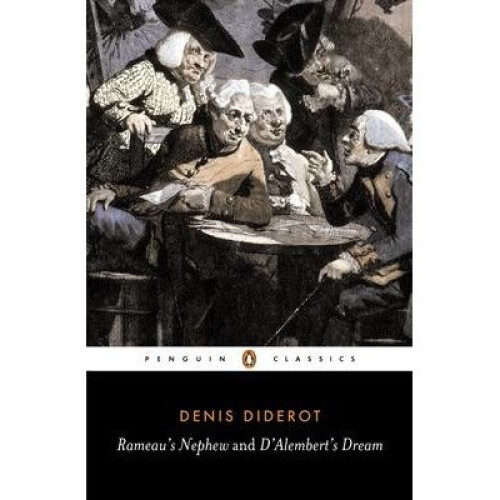
Rameau's Nephew / D'alembert's Dream
In stock
Smart shoppers OnBuy it!
- Earn Cashback on every purchase – spend it instantly on your next order
- Free delivery – on millions of items across the site
- Customers love us – 136,000 Trustpilot reviews and an 'Excellent' rating
Interest-free payment options available


See full product description & details
Delivery: Standard (Free) | Fri 23rd - Thu 29th Oct
There are 2 other sellers
Returns: 30 days
180-day payment protection
You might also like








Rameau's Nephew / D'alembert's Dream Description
One of the key figures of the French Enlightenment, Denis Diderot was a passionate critic of conventional morality, society and religion. Among his greatest and most well-known works, these two dialogues are dazzling examples of his radical scientific and philosophical beliefs. In Rameau's Nephew, the eccentric and foolish nephew of the great composer Jean-Philippe Rameau meets Diderot by chance, and the two embark on a hilarious consideration of society, music, literature, politics, morality and philosophy. Its companion-piece, D'Alembert's Dream, outlines a material, atheistic view of the universe, expressed through the fevered dreams of Diderot's friend D'Alembert. Unpublished during his lifetime, both of these powerfully controversial works show Diderot to be one of the most advanced thinkers of his age, and serve as fascinating testament to the philosopher's wayward genius.Details
| OPC | P6CV8R |
|---|---|
| Codes | 0140441735 (ISBN-10) |
| 9780140441734 (ISBN) |
Detailed Product Information
| Release Date | 29/07/1976 |
|---|---|
| Book Type | Paperback |
| Publisher | Penguin Books Ltd |
| Author | Denis Diderot |
| Release Date | 29/07/1976 |
| Book Type | Paperback |
| Publisher | Penguin Books Ltd |
| Author | Denis Diderot |
| Release Date | 29/07/1976 |
| Book Type | Paperback |
| Publisher | Penguin Books Ltd |
| Author | Denis Diderot |
Disclaimer: The information below is provided by various external sources and should be used as a guide only.
Rameau’s Nephew and D’Alembert’s Dream
Voltaire, Rousseau, Diderot—of the triumvirate that dominated French letters in the eighteenth century, Diderot was unmatched in the sheer breadth and depth of his interests and ideas. Rameau’s Nephew and D’Alembert’s Dream are dazzling exposés of Diderot’s radical scientific and philosophical thinking. Written in dialogue form, they were too outspoken to be published during the lifetime of one whose ideas earned him enemies as fast as they stimulated new criteria for social progress. Of the two pieces, Rameau’s Nephew was composed over many years, and in form and content it is an explosive cocktail unlike anything in French literature before or since. D’Alembert’s Dream, on the other hand, was committed to paper in a matter of days; a clarion call for the cause of materialist determinism, it too shows Diderot as one of the most advanced thinkers of his age and is a powerful testament to the bizarre and unpredictable genius of its creator.
About author(s)
Denis Diderot was born at Langres in eastern France in 1713, the son of a master cutler. He was originally destined for the Church but rebelled and persuaded his father to allow him to complete his education in Paris, where he graduated in 1732. For ten years Diderot was nominally a law student, but actually led a precarious bohemian but studious existence, eked out with tutoring, hack-writing and translating. His original writing began in 1746 with a number of scientific works setting out the materialist philosophy which he was to hold throughout his life. Along with his editorship of the Encyclopédie (1747-73), he wrote works on mathematics, medicine, the life sciences, economics, drama and painting, two plays and a novel, as well as his Salons (1759-81). His political writings were mainly composed around 1774 for Catherine II, at whose invitation he went to St. Petersburg. Diderot’s astonishingly wide range of interests, together with his growing prediliction for the dialogue form, led to the production of his most famous works: D’Alembert’s Dream, The Paradox of the Actor, Jacques the Fatalist and Rameau’s Nephew. During the latter part of his life Diderot received a generous pension from Catherine II, in return for which he bequeathed her his library and manuscripts. He died in 1784.
Rameau’s Nephew and D’Alembert’s Dream
Voltaire, Rousseau, Diderot—of the triumvirate that dominated French letters in the eighteenth century, Diderot was unmatched in the sheer breadth and depth of his interests and ideas. Rameau’s Nephew and D’Alembert’s Dream are dazzling exposés of Diderot’s radical scientific and philosophical thinking. Written in dialogue form, they were too outspoken to be published during the lifetime of one whose ideas earned him enemies as fast as they stimulated new criteria for social progress. Of the two pieces, Rameau’s Nephew was composed over many years, and in form and content it is an explosive cocktail unlike anything in French literature before or since. D’Alembert’s Dream, on the other hand, was committed to paper in a matter of days; a clarion call for the cause of materialist determinism, it too shows Diderot as one of the most advanced thinkers of his age and is a powerful testament to the bizarre and unpredictable genius of its creator.
About author(s)
Denis Diderot was born at Langres in eastern France in 1713, the son of a master cutler. He was originally destined for the Church but rebelled and persuaded his father to allow him to complete his education in Paris, where he graduated in 1732. For ten years Diderot was nominally a law student, but actually led a precarious bohemian but studious existence, eked out with tutoring, hack-writing and translating. His original writing began in 1746 with a number of scientific works setting out the materialist philosophy which he was to hold throughout his life. Along with his editorship of the Encyclopédie (1747-73), he wrote works on mathematics, medicine, the life sciences, economics, drama and painting, two plays and a novel, as well as his Salons (1759-81). His political writings were mainly composed around 1774 for Catherine II, at whose invitation he went to St. Petersburg. Diderot’s astonishingly wide range of interests, together with his growing prediliction for the dialogue form, led to the production of his most famous works: D’Alembert’s Dream, The Paradox of the Actor, Jacques the Fatalist and Rameau’s Nephew. During the latter part of his life Diderot received a generous pension from Catherine II, in return for which he bequeathed her his library and manuscripts. He died in 1784.
Alternative names:
- ISBN Rameau’s Nephew and D’Alembert’s Dream
- ISBN Rameau’s Nephew and D’Alembert’s Dream
Detailed Product Information
Features
| Language version | English |
|---|---|
| Genre | Classics |
| Release date (DD/MM/YYYY) | 28/10/1976 |
| Number of pages | 240 pages |
| Written by | Denis Diderot |
| Publisher | Penguin Classics |
| International Standard Book Number (ISBN) | 9780140441734 |
| Translator | Leonard Tancock |
| Book cover type | Paperback |
Customers also buy
Compare Sellers for Rameau's Nephew / D'alembert's Dream
- New from £11.20
| Seller | Ratings | Warranty | Returns | Price | Delivery | Total | Quantity |
|---|---|---|---|---|---|---|---|
| (3.3k reviews) | - |
30 Days
Free Returns No
|
£11.20
|
+Free Delivery
Est. Delivery:
23rd-29th Oct
|
£11.20
Recommended
We recommend listings based on a combination of price, delivery time, quality of seller reviews and other factors
|
||
| (207 reviews) | - |
30 Days
Free Returns No
|
£15.03
|
+Free Delivery
Est. Delivery:
16th-19th Oct
|
£15.03
|
||
| (1.6k reviews) | - |
30 Days
Free Returns No
|
£11.49
|
+£3.00 Delivery
Est. Delivery:
28th Oct - 16th Nov
|
£14.49
|
Earn as you shop with instant Cashback on everything.
No catch, no cost
- Paid into your OnBuy account
- Spend it on your next purchase
- Save it or withdraw it
Become a Cashback VIP
Just 1 purchase unlocks bigger deals & rates