





















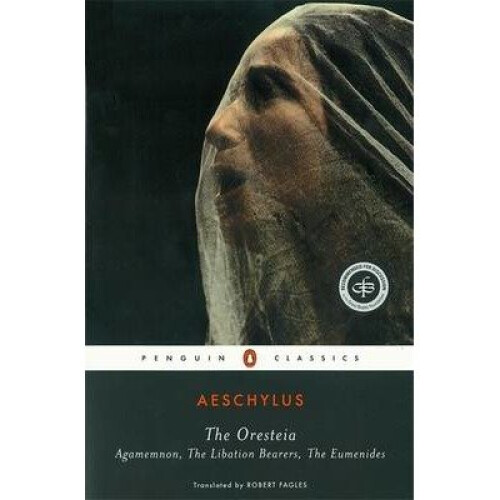
The Oresteia: Agamemnon, the Libation Bearers, the Eumenides
In stock
Smart shoppers OnBuy it!
- Earn Cashback on every purchase – spend it instantly on your next order
- Free delivery – on millions of items across the site
- Customers love us – 137,000 Trustpilot reviews and an 'Excellent' rating
Interest-free payment options available



See full product description & details
Delivery: Standard (Free) | Thu 29th - Fri 30th Oct
There are 2 other sellers
Returns: 30 days
180-day payment protection
The Oresteia: Agamemnon, the Libation Bearers, the Eumenides Description
The only trilogy in Greek drama that survives from antiquity, Aeschylus' The Oresteia is translated by Robert fagles with an introduction, notes and glossary written in collaboration with W.B. Stanford in Penguin Classics. In the Oresteia Aeschylus addressed the bloody chain of murder and revenge within the royal family of Argos. As they move from darkness to light, from rage to self-governance, from primitive ritual to civilized institution, their spirit of struggle and regeneration becomes an everlasting song of celebration. In Agamemnon, a king's decision to sacrifice his daughter and turn the tide of war inflicts lasting damage on his family, culminating in a terrible act of retribution; The Libation Bearers deals with the aftermath of Clytemnestra's regicide, as her son Orestes sets out to avenge his father's death; and in The Eumenides, Orestes is tormented by supernatural powers that can never be appeased. Forming an elegant and subtle discourse on the emergence of Athenian democracy out of a period of chaos and destruction, The Oresteia is a compelling tragedy of the tensions between our obligations to our families and the laws that bind us together as a society. Aeschylus (525-456 BC) was born near Athens. He wrote more than seventy plays, of which seven have survived, all translated for Penguin Classics: The Supplicants, The Persians, Seven Against Thebes, Prometheus Bound, Agamemnon, The Libation Bearers and The Eumenides. If you enjoyed The Oresteia, you might like Euripides' Medea and Other Plays, also available in Penguin Classics. 'Conveys more vividly and powerfully than any of the ten competitors I have consulted the eternal power of this masterpiece ...a triumph' Bernard Levin 'How satisfying to read at last a modern translation which is rooted in Greek feeling and Greek thought ...both the stature and the profound instinctive genius of Aeschylus are recognised' Mary Renault, author of The King Must DieDetails
| OPC | P6CY8W |
|---|---|
| Codes | 0140443339 (ISBN-10) |
| 9780140443332 (ISBN) |
Detailed Product Information
| Author | Aeschylus |
|---|---|
| Publisher | Penguin Books Ltd |
| Book Type | Paperback |
| Release Date | 29/09/1977 |
| Author | Aeschylus |
| Publisher | Penguin Books Ltd |
| Book Type | Paperback |
| Release Date | 29/09/1977 |
| Author | Aeschylus |
| Publisher | Penguin Books Ltd |
| Book Type | Paperback |
| Release Date | 29/09/1977 |
Disclaimer: The information below is provided by various external sources and should be used as a guide only.
The Oresteia
In the Oresteia Aeschylus addressed the bloody chain of murder and revenge within the royal family of Argos. As they move from darkness to light, from rage to self-governance, from primitive ritual to civilized institution, their spirit of struggle and regeneration becomes an everlasting song of celebration. In Agamemnon, a king’s decision to sacrifice his daughter and turn the tide of war inflicts lasting damage on his family, culminating in a terrible act of retribution; The Libation Bearers deals with the aftermath of Clytemnestra’s regicide, as her son Orestes sets out to avenge his father’s death; and in The Eumenides, Orestes is tormented by supernatural powers that can never be appeased. Forming an elegant and subtle discourse on the emergence of Athenian democracy out of a period of chaos and destruction, The Oresteia is a compelling tragedy of the tensions between our obligations to our families and the laws that bind us together as a society.
The only trilogy in Greek drama that survives from antiquity, Aeschylus’ The Oresteia is translated by Robert Fagles with an introduction, notes and glossary written in collaboration with W.B. Stanford in Penguin Classics.
For more than seventy years, Penguin has been the leading publisher of classic literature in the English-speaking world. With more than 1,700 titles, Penguin Classics represents a global bookshelf of the best works throughout history and across genres and disciplines. Readers trust the series to provide authoritative texts enhanced by introductions and notes by distinguished scholars and contemporary authors, as well as up-to-date translations by award-winning translators.
About author(s)
Aeschylus was born of a noble family near Athens in 525 BC. He took part in the Persian Wars and his epitaph, said to have been written by himself, represents him as fighting at Marathon. At some time in his life he appears to have been prosecuted for divulging the Eleusinian mysteries, but he apparently proved himself innocent. Aeschylus wrote more than seventy plays, of which seven have survived: The Suppliants, The Persians, Seven Against Thebes, Prometheus Bound, Agamemnon, The Choephori, and The Eumenides. (All are translated for Penguin Classics.) He visited Syracuse more than once at the invitation of Hieron I and he died at Gela in Sicily in 456 BC. Aeschylus was recognized as a classic writer soon after his death, and special privileges were decreed for his plays.
Alternative names:
- ISBN The Oresteia
Detailed Product Information
Weight & dimensions
| Height | 196.8 mm |
|---|---|
| Width | 128.6 mm |
Features
| Language version | English |
|---|---|
| Genre | Classics |
| Release date (DD/MM/YYYY) | 07/02/1984 |
| Number of pages | 336 pages |
| Written by | Aeschylus |
| Publisher | Penguin Classics |
| International Standard Book Number (ISBN) | 9780140443332 |
| Translator | Robert Fagles |
| Book cover type | Paperback |
Compare Sellers for The Oresteia: Agamemnon, the Libation Bearers, the Eumenides
- New from £12.11
| Seller | Ratings | Warranty | Returns | Price | Delivery | Total | Quantity |
|---|---|---|---|---|---|---|---|
| (2.6k reviews) | - |
30 Days
Free Returns No
|
£12.11
|
+Fast & Free Delivery
Est. Delivery:
29th-30th Oct
|
£12.11
Recommended
We recommend listings based on a combination of price, delivery time, quality of seller reviews and other factors
|
||
| (3.4k reviews) | - |
30 Days
Free Returns No
|
£12.73
|
+Free Delivery
Est. Delivery:
10th-16th Nov
|
£12.73
|
||
| (209 reviews) | - |
30 Days
Free Returns No
|
£16.63
|
+Free Delivery
Est. Delivery:
4th-6th Nov
|
£16.63
|
Earn as you shop with instant Cashback on everything.
No catch, no cost
- Paid into your OnBuy account
- Spend it on your next purchase
- Save it or withdraw it
Become a Cashback VIP
Just 1 purchase unlocks bigger deals & rates